

Data last updated: September 28, 2026
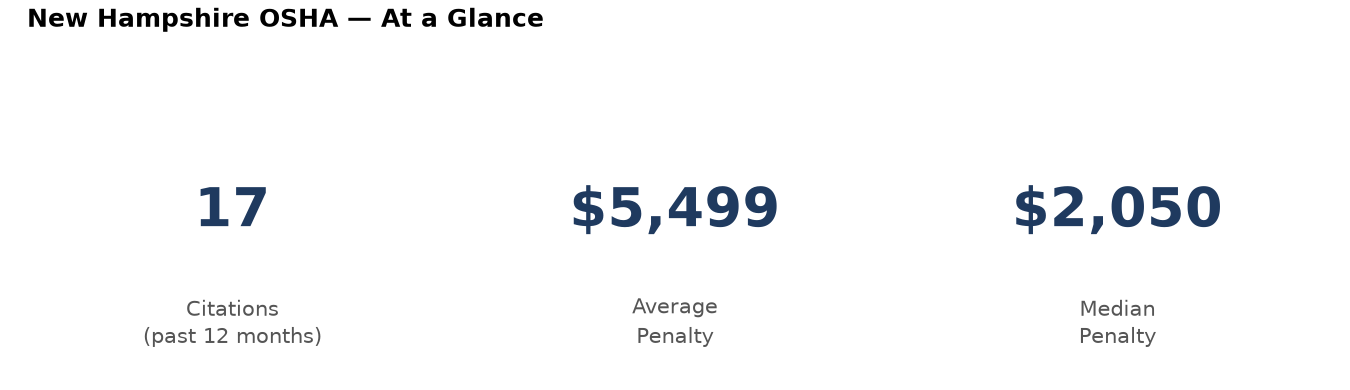
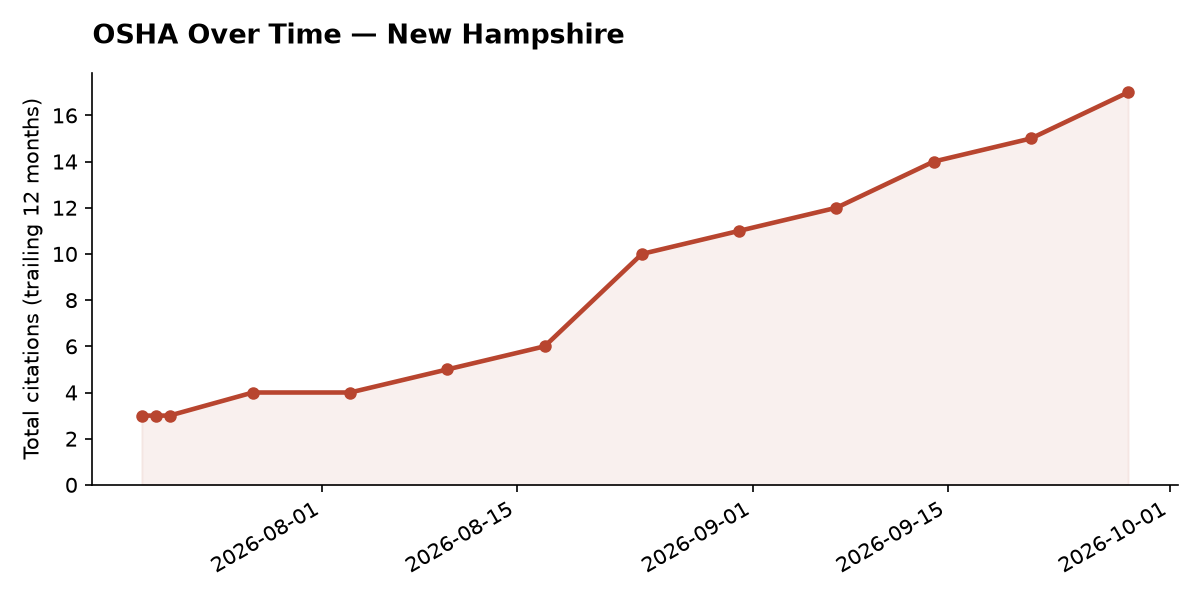
Seventeen fall protection citations landed on New Hampshire employers over the past 12 months, with an average penalty of $5,499 and a median of $2,050. That gap between average and median tells you something: a handful of harsher cases, including one classified as Willful, are pulling the average up well above what most employers actually paid. If you’ve just opened an envelope from OSHA, the number on it matters a lot less than what you do in the next few weeks.
If you’re staring down a citation right now, the clock is already running. Talk to a New Hampshire OSHA defense attorney before you decide how to respond.
What OSHA Actually Requires Once Work Moves Off the Ground
Every one of these New Hampshire cases traces back to the same rule: 29 CFR 1926.501, the core fall protection standard for construction. In plain terms, once a worker is exposed to a fall of six feet or more onto a lower level, the employer has to do something about it — guardrails, safety nets, or a personal fall arrest system. There’s no waiting period and no exception for a quick job. The standard doesn’t care whether the task takes ten minutes or ten hours; it cares whether a worker was exposed without protection while the citation clock was running. You can read the full breakdown of how this rule gets applied on our 1926.501 standard overview.
What separates a routine Serious citation from something worse comes down to history and knowledge. Ten of the seventeen New Hampshire citations were classified as Serious — meaning OSHA determined the employer knew or should have known about the hazard. Five were Repeat citations, which means the same employer had been cited for a similar violation before, and those carry steeper penalties by design. One was Other-than-Serious, and one was Willful — the most severe category, reserved for cases where OSHA believes the employer showed intentional disregard or plain indifference to the requirement.
Roofing Crews Account for Most of the State’s Citations
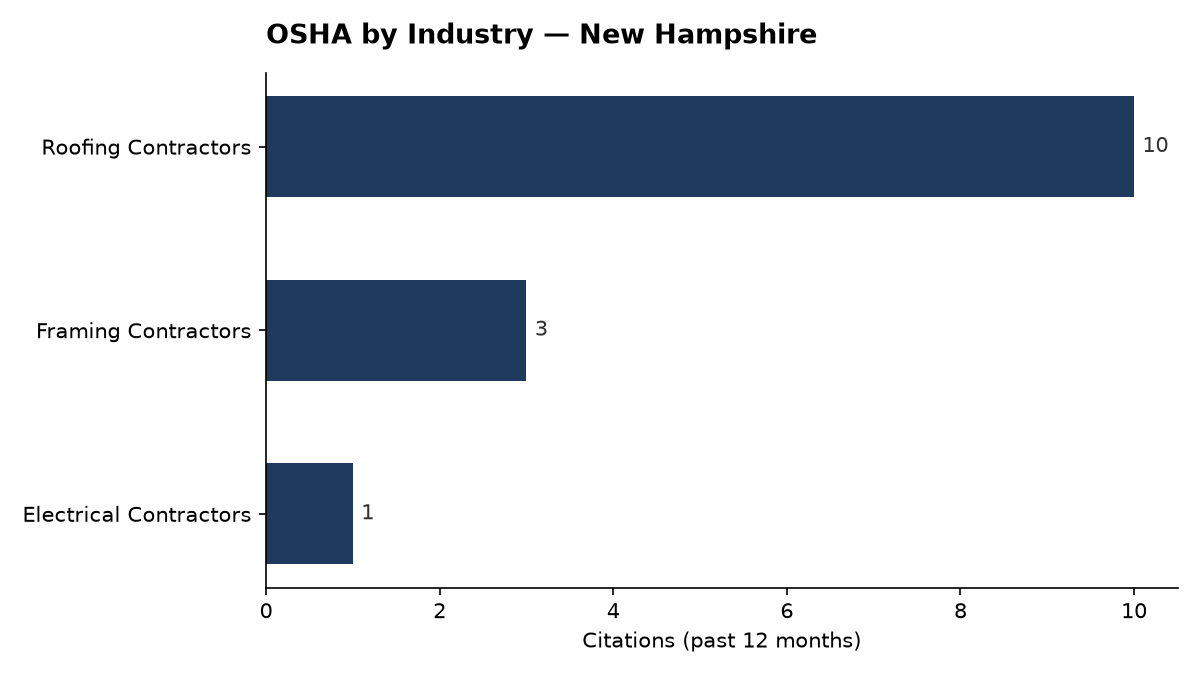
Ten of the seventeen citations, well over half, went to roofing contractors. That’s not surprising given the nature of the work: roofers are routinely operating at height on pitched, unguarded surfaces, often on residential jobs where anchor points and guardrail systems take real time to set up. Framing contractors picked up three citations, and electrical contractors accounted for one. If you run a roofing operation, this pattern is worth studying closely, because it’s exactly where OSHA compliance officers in this state are already looking.
Concord stands out as the city with the most citations in this data set, which lines up with two of the five named cases below being based there. That doesn’t mean OSHA is targeting Concord specifically — it likely reflects where enforcement staff are stationed and where construction activity is concentrated — but it does mean employers working job sites in and around Concord should assume a higher chance of a site visit.
What These Citations Actually Cost New Hampshire Employers
The dollar figures in New Hampshire’s recent record vary widely by classification. Pl Construction Corporation in Concord was cited $26,482 for a Willful violation under 19260501 B13, issued June 5, 2026. Best Pro Smg Construction Corp. in Laconia was hit with a $24,825 Repeat citation, also under B13, issued January 30, 2026. Marquis Roofing And Exterior Design Llc in Farmington faced a $9,930 Repeat citation under B10, issued June 5, 2026. Ortega General Construction Corp in Nashua was cited $8,341 for a Repeat violation under B13, issued June 23, 2026. And Mas Pro Contractors, Inc., also in Concord, was cited $6,256, also Repeat and under B13, issued July 29, 2026.
Notice how much the Repeat and Willful classifications drive up the number compared to the state’s $2,050 median. That’s the pattern to understand: a first-time Serious citation for a straightforward fall hazard often lands closer to the median, but a Repeat finding — proof that OSHA has cited this same employer before for something similar — multiplies the exposure fast. It’s also worth knowing that the average penalty reduction in New Hampshire, comparing initial proposed penalties to final settled amounts, runs about 26%. That’s a meaningful gap, and it exists largely because employers who engage counsel and negotiate or contest often get somewhere better than the number on the first notice. Our breakdown of how these penalty amounts get calculated walks through the math OSHA uses.
A 26% average reduction is not something that happens by accident or by waiting quietly. Before you assume the initial figure is final, get a New Hampshire OSHA defense attorney to look at the specifics of your case.
Your Window to Push Back Is Short — Don’t Let It Close
Here’s the part employers miss most often: you have exactly 15 working days from the date you receive an OSHA citation to file a Notice of Contest. Miss that window, and the citation — classification, penalty, everything — becomes final and legally binding, whether or not you agree with it. There’s no informal grace period once those 15 working days pass.
That doesn’t mean every citation should be contested outright. Sometimes the smarter move is negotiating directly with the area office, especially for a first Serious citation with a modest penalty. But for Repeat or Willful classifications — the kind that carried the heaviest numbers in New Hampshire’s recent record — the classification itself is often worth fighting, because it follows your company into future inspections and inflates penalties on anything that comes after. Our guide to how to contest an OSHA citation covers the mechanics of filing and what happens after you do.
Given how tight that 15-working-day deadline is, and how much a Repeat or Willful label can cost you down the road, this isn’t a decision to make alone at your desk. Reach out to a New Hampshire OSHA defense attorney now, while you still have time to act on the citation instead of just accepting it.
If you’ve received a fall protection citation in New Hampshire, pull together the citation paperwork, note the issuance date, and count backward from the 15-working-day deadline today — then get an attorney’s eyes on it before that window closes.