
Data last updated: September 14, 2026
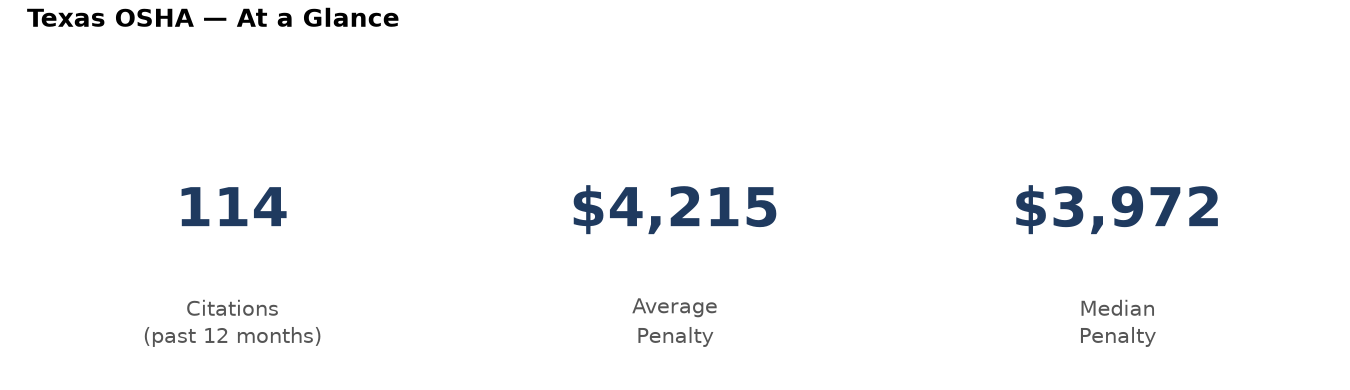
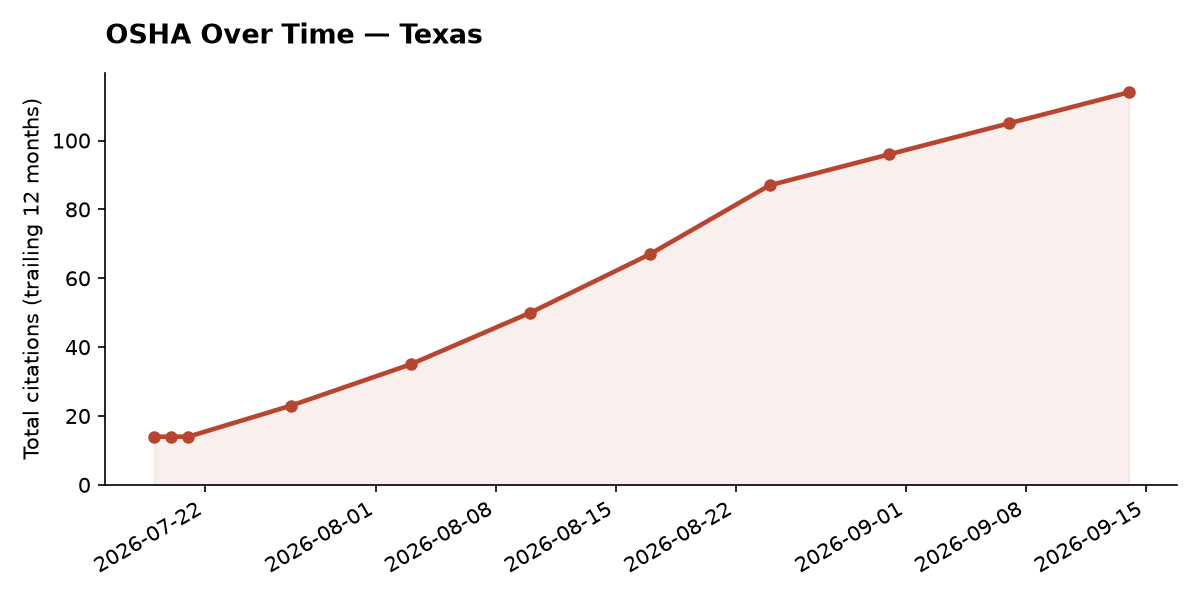
Over the past 12 months, OSHA issued 114 fall protection citations across Texas under standard 1926.501, with an average penalty of $4,215 and a median of $3,972. Framing contractors alone accounted for 53 of those citations, nearly half the statewide total, and Forney turned up as the city with the most cases on record.
If you run a framing, roofing, or trade contracting business in Texas and a citation has landed on your desk, the clock is already moving. Talking to a Texas OSHA defense attorney before you respond can change how much you end up owing and whether the citation sticks at all.
What 1926.501 Actually Requires on a Texas Jobsite
The rule behind nearly all of these cases, 1926.501, is not complicated in concept: once a worker is exposed to a fall of six feet or more in construction, the employer has to provide protection. That means guardrails, safety nets, or a personal fall arrest system set up correctly, not just available on the truck.
Where employers get tripped up isn’t usually a philosophical disagreement about safety. It’s execution: a crew working a roof edge without tie-off, a framing gang moving fast on an upper deck, a subcontractor assuming someone else handled the anchor points. OSHA doesn’t require intent to cite a violation. The exposure itself is the trigger.
Framing and Roofing Crews Are Carrying Texas’s Citation Total
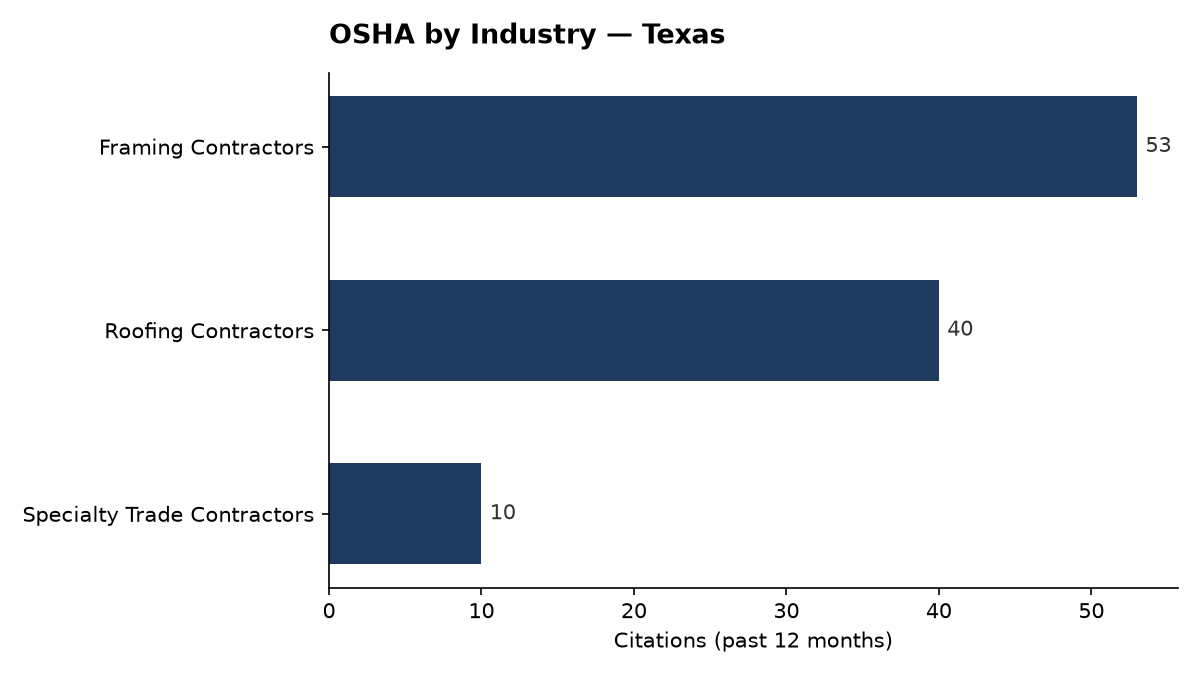
Look at where these 114 citations landed and the pattern is obvious. Framing contractors picked up 53 citations, roofing contractors added another 40, and specialty trade contractors accounted for 10 more. Together, framing and roofing make up more than 80 percent of all fall protection enforcement in the state.
That concentration makes sense given the nature of the work. Framing crews spend entire shifts on open upper floors and trusses before any permanent guardrail goes up. Roofing crews work slopes and edges by definition. Both trades move fast on production schedules, which is exactly the environment where fall protection gets skipped or improvised. OSHA compliance officers know this, and Texas construction sites in these trades draw disproportionate attention as a result.
Serious and Repeat Findings Are Driving the Cost
Of the 114 citations, 98 were classified as Serious, meaning OSHA determined the hazard could realistically cause death or serious physical harm. Eleven were Repeat citations, and five were Other-than-Serious. That Repeat number matters more than it might look at first glance, because a second citation for the same or a similar violation carries a much steeper penalty than a first-time Serious finding, sometimes several times higher.
You can see that spread in the real cases on file. Rpm Installation, Llc in Fort Worth was cited $14,895 for a Serious violation under 19260501 B01, issued July 20, 2026. Strautman Neely, Llc in Beaumont drew $13,902 for a Serious violation under 19260501 B04 I, issued July 30, 2026. Martinez Brothers Contractors Llc in El Paso was cited $11,917 for an Other-than-Serious finding under 19260501 B01, issued July 08, 2026.
Two of the cases on record are Repeat citations, and both carried the same $11,916 penalty under 19260501 B13: Juan Flores Olivas in Glenn Heights, issued September 25, 2025, and Porfirio Vargas-Brito in Royse City, issued October 16, 2025. A Repeat designation tells OSHA, and eventually a judge, that this isn’t a first-time lapse, which is exactly why these cases are harder to settle down after the fact.
Statewide, the average penalty reduction between initial issuance and final resolution runs about 13 percent, which reflects how OSHA fall protection violations penalty amounts typically move once an employer pushes back, corrects the hazard, and negotiates rather than simply paying the initial number.
A 13 percent average reduction is not automatic, and it rarely happens without someone making the case for it. Before you write a check, it’s worth a conversation with a Texas OSHA defense attorney about what your specific citation might be worth contesting.
The 15-Day Window You Cannot Afford to Miss
Once a citation is issued, you have 15 working days to file a Notice of Contest. Miss that window and the citation becomes a final order automatically, no matter how strong your defense might have been. There’s no extension built into the process for being busy running a jobsite or waiting to see if OSHA follows up.
Inside that window, you have real options: you can request an informal conference with the area office, negotiate the classification or penalty, or formally contest the citation and preserve your right to a hearing. Each path has different implications for cost, for your OSHA history going forward, and for how a Repeat finding might affect you on a future job. The process for how to contest an OSHA citation is procedural, and the deadlines inside it are unforgiving.
This is not a form you want to fill out alone the night before it’s due. A lawyer who handles Texas OSHA cases regularly can tell you within a short conversation whether your citation has a real weak point, whether the classification is defensible, and whether the 13 percent average reduction is realistic for your situation or whether you should be pushing for more.
With 114 citations already on the books in Texas this year and average penalties north of $4,000 before any Repeat or Willful multiplier kicks in, the smart move is to get a Texas OSHA defense attorney reviewing your citation now, while your 15 working days are still running.
Whatever stage you’re at, whether the citation just arrived or you’re still waiting to hear back from the area office, treat the next 15 working days as the most important window in this process. Pull your paperwork together, note the exact issuance date, and get a professional opinion before that deadline closes on its own.