
Data last updated: September 21, 2026
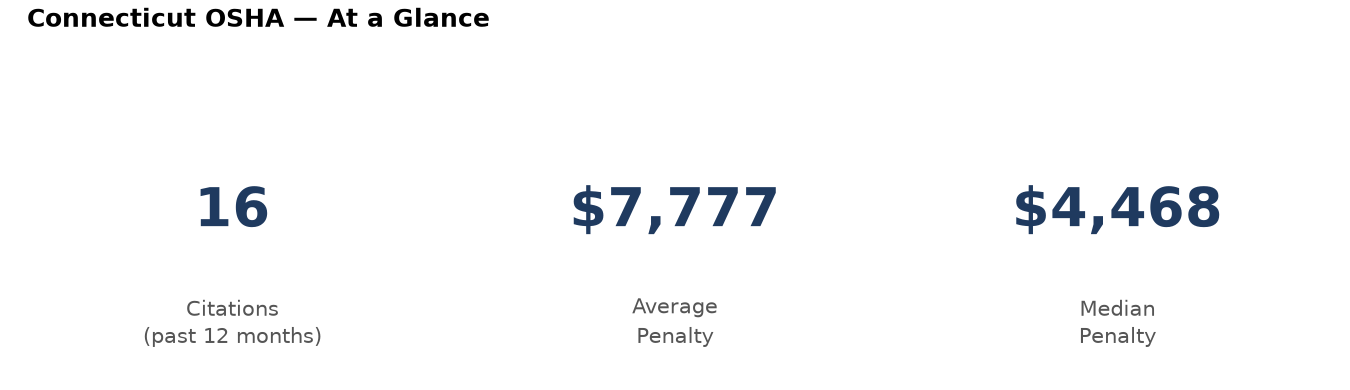
Connecticut OSHA inspectors issued 16 fall protection citations over the past 12 months, with an average penalty of $7,777 and a median of $4,468. Hartford led the state in citation activity, and one case in East Haven carried a Willful classification with a $33,103 fine. If you have a citation in hand, or you just got word that an inspector is coming, the numbers below tell you what you are actually up against.
If you have received a citation, the clock is already running. Talk to a Connecticut OSHA defense attorney before you decide how to respond.
What Inspectors Are Actually Checking For
Every one of these 16 cases traces back to a single rule: 29 CFR 1926.501, the general fall protection standard for construction. In plain terms, it says once a worker is exposed to a fall of six feet or more to a lower level, the employer has to have already put something in place to stop that fall before it happens ‑ a guardrail system, a safety net, or a personal fall arrest system with a harness and anchor point. There is no grace period and no waiting to see if someone slips. OSHA does not care whether the job is a two-day roof patch or a six-month framing project; the exposure triggers the duty the moment someone steps above that six-foot line without protection.
Inspectors look for gaps at roof edges, skylights, floor openings, and leading edges where framing crews are working ahead of the next floor going in. They also check whether fall arrest gear that is present is actually being used correctly, since having a harness on-site but unused or improperly anchored does not satisfy the standard.
Roofing Work Dominates Connecticut’s Citation List
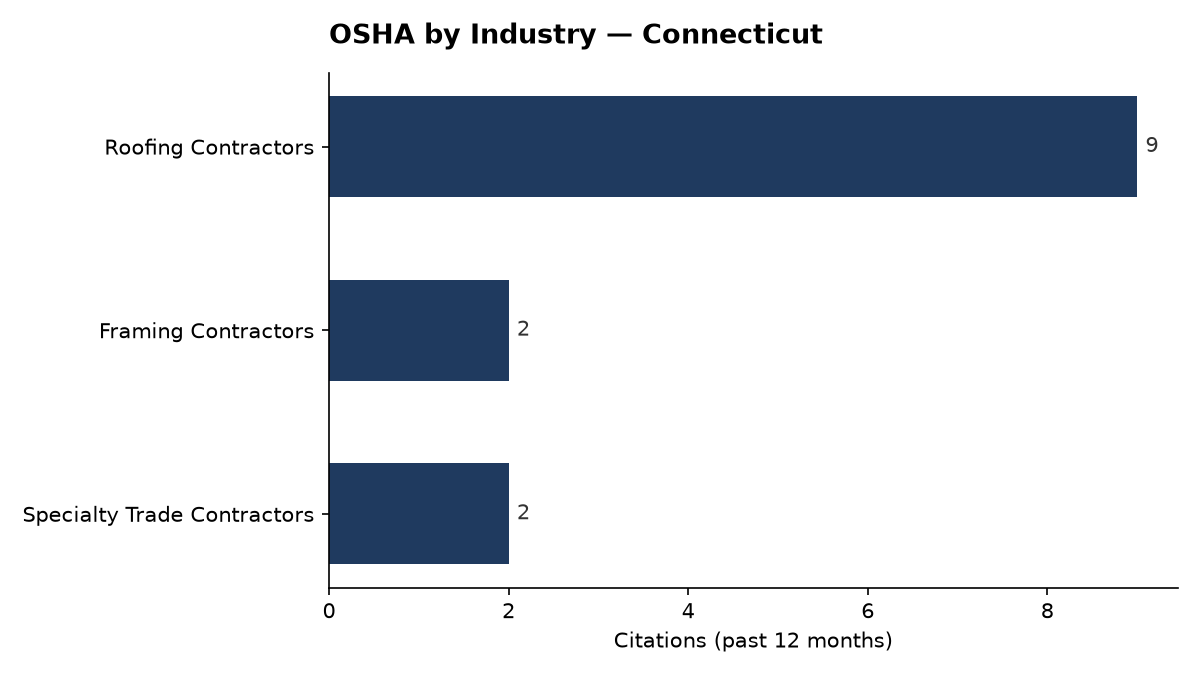
Nine of the state’s 16 citations, well over half, went to roofing contractors. That is not a coincidence. Roofing puts workers at height on nearly every job, often with steep pitches, edge exposure, and tight timelines that push crews to skip tie-off steps to keep pace. Framing contractors picked up 2 citations, and general specialty trade contractors accounted for another 2. Together, these three categories make up the entire list, which tells you enforcement in Connecticut is concentrated almost entirely in trades that put people above ground level as a normal part of the job, not in office work or light industrial settings.
Two of the state’s cases were classified as Repeat, meaning the employer had a substantially similar violation on record from a prior inspection. Tactical Construction Services, LLC in Enfield was cited $11,916 under 1926.501(b)(11) as a Repeat violation, and Tacury Roofing and Siding LLC in Wethersfield was cited $9,930 under 1926.501(b)(13), also Repeat, issued March 24. Repeat findings tend to draw sharply higher penalties than a first-time Serious citation for the exact same hazard, because OSHA’s penalty structure is built to punish employers who were already put on notice.
What These Citations Actually Cost in Connecticut
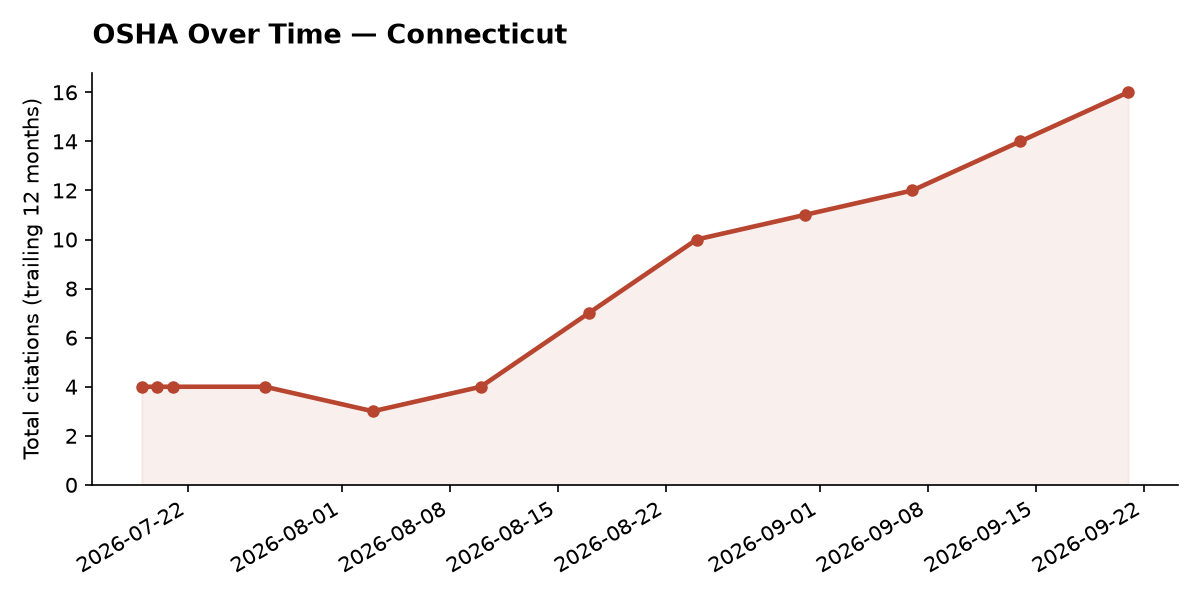
Of the 16 citations, 11 were classified Serious, 2 Repeat, 2 Other-than-Serious, and 1 Willful. That single Willful case belongs to Chacon Roofing, LLC in East Haven, cited $33,103 under 1926.501(b)(13) and issued February 26 ‑ by far the largest penalty in the state’s fall protection record for this period, and a reminder that a Willful tag can push a fine into a different bracket entirely compared to a routine Serious violation. Premier Building Associates LLC, also in East Haven, was cited $15,000 as Other-than-Serious under the same subsection, issued February 5. Seci Construction Inc. in Hartford was cited $11,585 as Serious under 1926.501(b)(13), issued April 7.
Here’s the detail that matters most if you are deciding how to respond to a citation: the average penalty reduction between the initial citation amount and the final settled amount in Connecticut was 15%. That gap does not happen by accident. It happens because employers negotiate, provide additional documentation, or formally contest, and OSHA revises the number accordingly. Understanding how these penalty amounts are actually calculated is the first step to knowing whether your number is fair or inflated.
A 15% average reduction means real money is on the table in almost every case. Before you pay a citation at face value, it is worth a conversation with a Connecticut OSHA defense attorney to see whether your penalty can be reduced or the citation itself challenged.
The 15-Day Window You Cannot Afford to Miss
Once a citation is issued, an employer has exactly 15 working days to file a Notice of Contest. Miss that window and the citation becomes a final order automatically, no matter how strong your defense might have been. There is no informal extension and no appeal process once that deadline passes. That is a short amount of time to gather documentation, review the cited subsection, and decide on a strategy, which is exactly why waiting until day 12 or 13 to start figuring out your options is a mistake.
If you believe the abatement date is unrealistic, the classification is too severe, or the underlying facts do not match what the inspector wrote up, contesting is often the only way to get those issues addressed. The process itself, including what happens after you file, is laid out in more detail on how to contest an OSHA citation, but the short version is that this is not a form you fill out alone at the last minute ‑ it is a decision that benefits from legal review of the actual citation language before the clock runs out.
With only 15 working days to act, get a Connecticut OSHA defense attorney reviewing your citation now, not after the contest deadline has already closed.
Whether your citation reads Serious, Repeat, or Willful, the number on the page is negotiable more often than most business owners assume, but only if someone starts working the case immediately. Pull your citation, check the issue date against the 15-working-day deadline, and get it in front of someone who handles these cases before that window closes.