
Data last updated: September 21, 2026
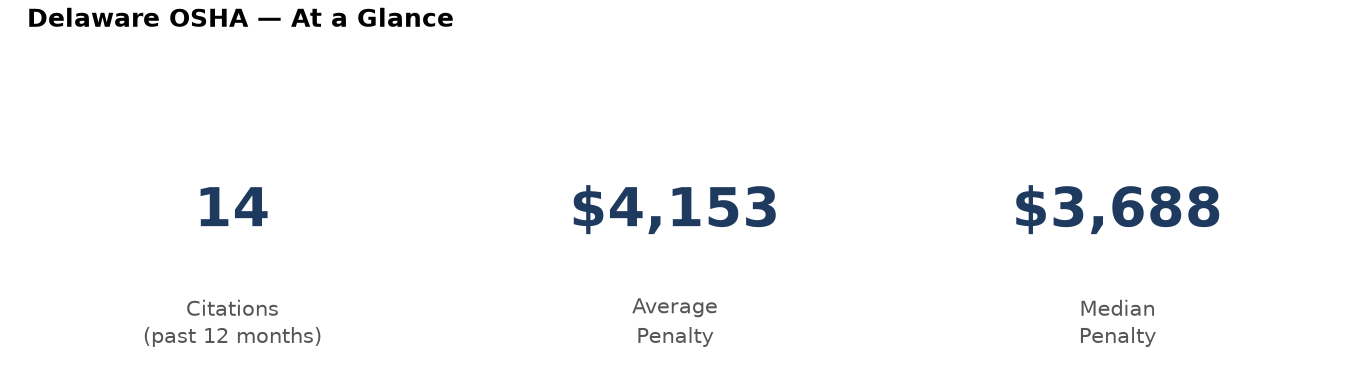
Delaware issued 14 fall protection citations over the past 12 months, with penalties averaging $4,153 and a median of $3,688. Thirteen of those citations were classified as Serious, and one carried a Repeat designation — a category that tells OSHA the employer had been cited for the same hazard before and typically triggers a much steeper fine. Rehoboth Beach led the state in citation activity, but the cases stretch from Wyoming to Newark to Milton.
If you or your company just got one of these citations, the clock is already running. Before you decide how to respond, it helps to talk to a Delaware OSHA defense attorney who handles fall protection cases specifically, not general business law.
The Rule Behind Nearly Every Delaware Fall Case: 1926.501
Almost every citation in this batch traces back to one standard: 29 CFR 1926.501, OSHA’s core fall protection rule for construction. The idea behind it is simple even though the enforcement isn’t: once a worker is exposed to a fall of roughly six feet or more onto a lower level, the employer has to have a system in place before that person starts working — not after an inspector shows up. That system can be a guardrail, a safety net, or a personal fall arrest setup (harness, lanyard, anchor point), but something has to be there.
What trips up Delaware contractors isn’t usually ignorance of the rule. It’s the gap between having equipment on the truck and actually having it in use at the moment someone is on a roof edge, a floor opening, or a leading edge during framing. OSHA inspectors write citations based on what workers were doing when observed, not what gear was available. You can read the full breakdown of what this standard demands on our 1926.501 fall protection guide.
Framing and Roofing Crews Account for Nearly Two-Thirds of Delaware’s Cases
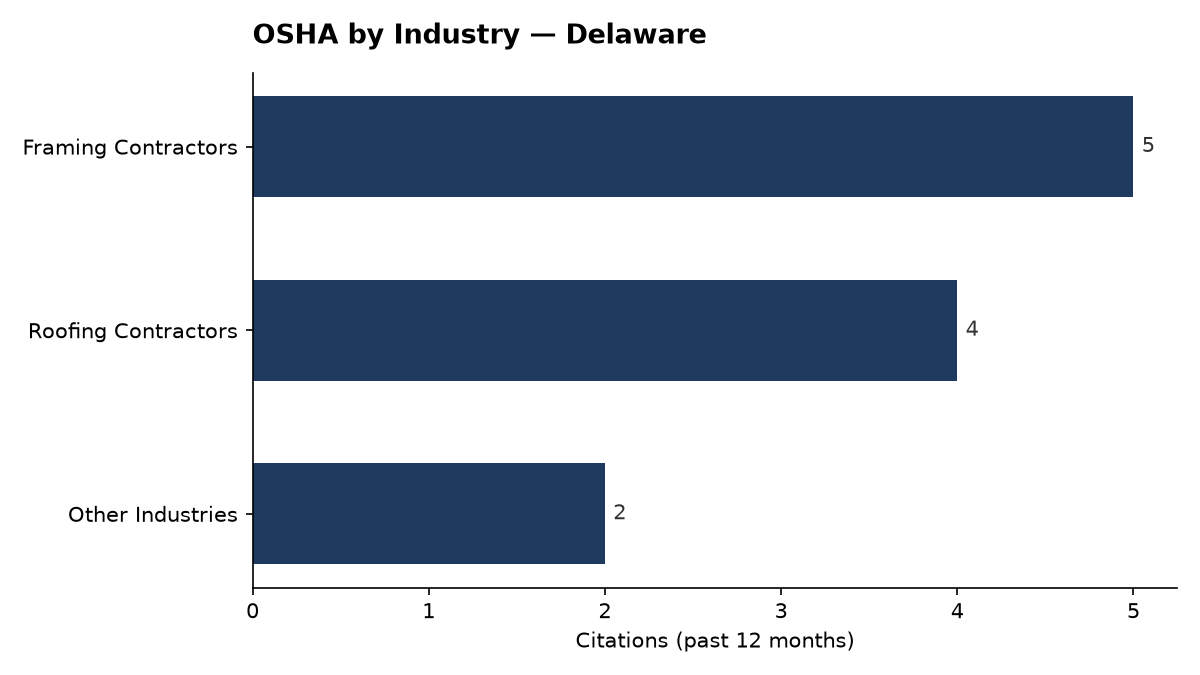
Of the 14 citations, five went to framing contractors and four to roofing contractors — together that’s 64% of every fall protection citation issued in the state this period. The remaining two went to businesses outside those trades entirely.
That split makes sense once you think about the work itself. Framing crews spend entire shifts moving across open floor systems and roof trusses before any permanent guardrail exists, and roofing crews are, by definition, working at height on sloped or unguarded surfaces for most of the job. Both trades also move fast — schedules are tight, and stopping to rig a personal fall arrest system for a five-minute task feels, to a lot of foremen, like it isn’t worth it. OSHA disagrees, and the citation history backs that up. If you run a framing operation in Delaware, it’s worth reviewing our guide for framing contractors on where inspectors typically look first.
What These Citations Actually Cost, in Real Delaware Cases
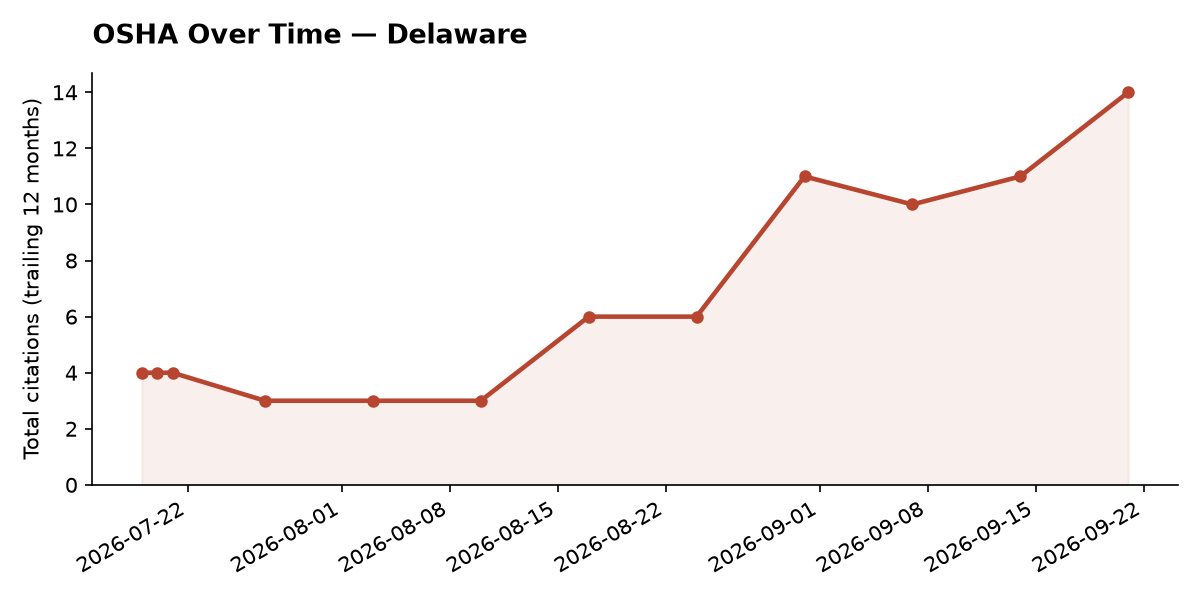
The average penalty of $4,153 doesn’t tell the whole story, because Serious and Repeat citations are priced very differently. A Serious violation reflects a hazard that could cause death or serious physical harm, and it makes up 13 of the 14 citations here. Repeat violations — the same or a substantially similar hazard cited again within the look-back window — are priced to punish, not just correct, and that shows up clearly in the data.
- Top Man Roofing, LLC (Wyoming) — $10,215, Repeat, cited under 1926.501(b)(13), issued January 30, 2026
- Dylan’s Construction LLC (Frederica) — $5,958, Serious, cited under 1926.501(b)(13), issued December 3, 2025
- M B Brothers Construction, LLC (Milton) — $4,256, Serious, cited under 1926.501(b)(13), issued May 28, 2026
- SP Builders Contractors Inc. (Newark) — $4,171, Serious, cited under 1926.501(b)(1), issued January 29, 2026
- ESP Business Services LLC (Magnolia) — $3,972, Serious, cited under 1926.501(b)(13), issued November 17, 2025
Notice that the single Repeat citation, against Top Man Roofing, carries more than double the median penalty for the state. That’s the pattern to watch: a first Serious citation is expensive, but a second citation for a similar hazard multiplies the cost fast. On the other side of the ledger, the average penalty reduction across Delaware cases that got negotiated or contested was 10% — meaning employers who pushed back, provided context, or corrected conditions quickly did shave real money off the initial number. You can see how these figures are typically calculated on our fall protection penalty breakdown.
A 10% reduction on a $10,000 citation is real money, but it rarely happens without someone pushing for it. Before you pay a citation at face value, it makes sense to get a Delaware OSHA defense attorney to look at whether the classification, the abatement date, or the underlying facts hold up.
The 15-Day Window That Decides Your Options
Once a citation arrives, OSHA gives you exactly 15 working days to file a Notice of Contest. Miss that window and the citation becomes a final order automatically — no hearing, no negotiation, no second look at whether the classification was fair. At that point, the penalty amount, the abatement requirements, and the violation history attached to your business are locked in.
That 15-day clock doesn’t pause for holidays, staffing shortages, or the time it takes to find a lawyer. It starts the day you receive the citation. Given that one Repeat citation in this state’s own data cost more than $10,000, and that even Serious citations averaged over $4,000, treating that deadline casually is a costly mistake. Our page on how to contest an OSHA citation walks through what the process actually involves, including what you need on hand before the clock runs out.
If you’ve received a fall protection citation in Delaware, or you’ve just gotten word that an inspection is coming, don’t wait to see how the paperwork shakes out on its own. Reach out to a Delaware OSHA defense attorney now, while you still have the full 15 working days to act.